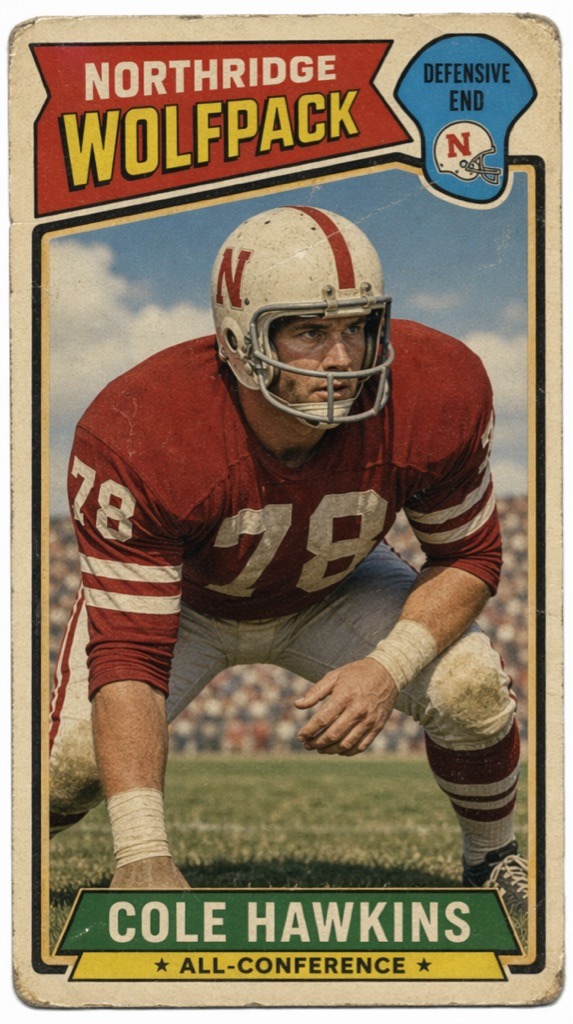
Cole Hawkins
Defensive End · Northridge Wolfpack
Unknown/Fictional Production. The card utilizes a design language heavily inspired by the 1971 Topps Football set, known for its colored borders and 'ribbon' nameplates. #Not visible on front; typically located on the reverse side of cards from this era.
Year & Era
Circa 1970s — Vintage Era. Designs from this era typically feature bold color blocks and iconic typography, carrying high nostalgia value for collectors of collegiate and gridiron history.
Card Type
Base Vintage Set — All-Conference Subset
Grade
2.0 (Good) estimated. The card shows significant heavy wear typical of a handled vintage item.
Rarity
Common/Mass-produced aesthetic. While seemingly rare because it is an obscure or custom-made item, it lacks the secondary market liquidity of licensed NFL stars.
Overall Assessment
A charming example of vintage-style football memorabilia. While the condition is poor and the subject is obscure, it serves as a perfect visual representation of 1970s hobby aesthetics.
Condition Grade
2.0 (Good) estimated. The card shows significant heavy wear typical of a handled vintage item.
Centering Assessment
Front: Approximately 60/40 Top-Bottom and 55/45 Left-Right. Relatively well-centered for the era, though the outer borders show significant aging.
Surface Condition
Poor to Fair. Visible staining, numerous scratches, and 'snow' (print speckling) across the image. Substantial foxing is present on the white borders.
Corner Condition
Poor. All four corners are heavily rounded with significant softenining and layer separation (delamination) visible.
Edge Condition
Fair. Noted chipping and roughness along the right and top edges. The card stock shows significant 'whiting' where the ink has worn away.
Print Quality
Moderate. The color saturation on the red jersey is high, but the image clarity is grainy, consistent with 1970s lithographic printing techniques.
Estimated Value
$5.00 - $15.00 USD. Value is nominal due to the fictional nature of the subject and the Poor/Fair condition.
Comparison to Known Examples
Compared to authentic 1971 Topps examples, this copy has significantly more corner wear and surface staining than a typical 'Mid-Grade' survivor.
Authentication Tips
Check card stock thickness and use a jeweler's loupe to verify the 'rosette' print pattern. Modern digital reprints will lack the layered ink feel of vintage letterpress or offset printing.
Grading Recommendation
Not recommended for professional grading. The cost of authentication and encapsulation would exceed the market value of the card.
Red Flags
The player and team names do not correspond to historical NFL or major NCAA records, suggesting this may be a prop card, a custom 'Aged' creation, or a fictionalized collectible.
Provenance Notes
Aesthetic suggests a 'found in shoebox' origin, though the forced aging of the stains can sometimes indicate a modern 'relic' created to look old.
Historical Context
The card captures the 'Golden Age' of defensive line play, characterized by the three-point stance and heavy taped wrists shown in the photography.
Market Trends
Niche/Novelty. Custom and fictional cards have been rising in the 'Art Card' segment of the hobby, but they do not follow the price spikes of Hall of Fame rookies.
Investment Potential
Low. This is a conversation piece or a 'type' card for a design collector rather than a financial asset.
Similar Cards
1971 Topps Jack Youngblood Rookie, 1971 Topps Joe Namath, or other 'Wolfpack' related collegiate memorabilia.
Display & Preservation
Store in a standard archival penny sleeve and top-loader to prevent further corner fraying or surface moisture damage.
Interesting Facts
The design is a direct homage to the 1971 Topps set, which is famous among collectors for being extremely difficult to find in high grades due to the easily-chipped red and blue borders.